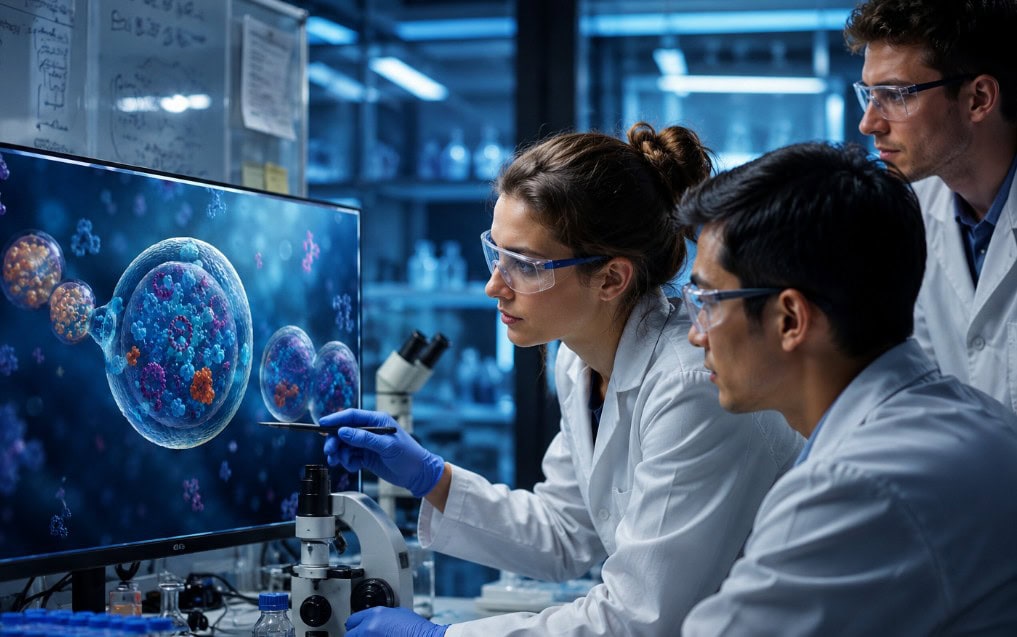
What is SpudCell? A lab-grown cell is able to grow, copy DNA, and divide.
Biological researchers have pursued one of biology’s most ambitious goals, creating a living cell entirely from nonliving components. Instead of modifying an existing organism, the idea is to assemble the cell piece by piece using carefully selected biological molecules.
Although researchers have made some progress over the years, integrating all the essential functions of life into an artificial system has been a huge challenge. Oh Research team A major step toward this goal, led by Kate Adamala at the University of Minnesota Twin Cities, has now been made using a technique called the spud cell.
A spud cell consists of tiny water droplets enclosed by a membrane made of fat molecules, which closely resembles the outer boundary of natural cells. Inside the droplet, the scientists housed a collection of cellular machinery with a tiny genome containing only 36 genes. This makes it dramatically less complex than the simplest bacteria, which typically require hundreds or thousands of genes to survive.
SpudCell performs key biological functions. First, it grows together with small vesicles that deliver nutrients and molecular components. Second, it is capable of copying its own DNA, and it can divide into smaller daughter droplets, although this process is still highly dependent on experimental intervention and is not yet completely autonomous.
The significance of the work lies not in creating a complete synthetic organism, but in showing that several basic cellular processes can work together within an artificial system. Previous research had successfully reproduced individual cellular activities in isolation, such as protein production or DNA replication. However, combining these processes into a coherent, functioning synthetic cell has proven more difficult because each biological reaction works best under different chemical conditions.
To overcome this challenge, the researchers relied on the PURE system, a laboratory-engineered collection of pure biological molecules capable of reading DNA instructions and producing proteins. Previous experiments had already shown that this system could work inside lipid vesicles, but these artificial cells could neither sustain growth nor reproduce using their own genetic information.
The team extended these first designs by engineering genes that produce specialized molecules on the surface of the membrane. These molecules act as docking sites for nutrient-filled vesicles, allowing the SpudCell to absorb material needed for growth and DNA replication.
For reproduction, the researchers introduced an additional molecular mechanism involving FLAG tags and streptavidin. When streptavidin is added to the surrounding solution, the interactions between these molecules create physical forces that eventually separate the droplet into two. Although effective as a proof-of-concept, this method is not always efficient and often requires researchers to mechanically assist in the distribution process.
Several limitations prevent the SpudCell from being classified as a living cell. Its protein-making machinery gradually breaks down because it cannot replace the damaged ribosomes. In addition, DNA does not divide continuously during division, causing many daughter cells to lose essential genetic information after repeated generations. As a result, artificial cells cannot sustain long-term reproduction or maintain stable populations.
The researchers explored whether the spud cell could reveal the beginnings of evolutionary behavior. By deliberately introducing a genetic mutation that increased the amount of nutrients, they observed that the mutated cells grew faster and gradually became more common in the population. However, this should not be seen as true evolution because both the variation and distribution processes were controlled by researchers rather than occurring naturally.
The research has attracted considerable attention within the scientific community. Many experts have hailed this achievement as a major technological breakthrough because it shows that multiple life-like functions can be integrated into a single artificial platform. At the same time, scientists cautioned that SpudCell is far from a real organism and its results still await formal peer review.
Artificial cells such as spud cells may eventually become valuable tools in medicine, biotechnology and environmental science. Researchers are looking at programmable artificial cells capable of delivering drugs directly to diseased tissues, producing useful chemicals, cleaning polluted environments, or performing industrial tasks more safely than genetically modified microorganisms.
Because every component of SpudCell is deliberately designed and understood, improvements can be made in a systematic way in the future.
Although many scientific challenges remain before fully artificial life becomes a reality, the spud cell shows that building increasingly sophisticated artificial cells is becoming technically feasible. Just as early airplanes proved that powered flight was possible despite their limitations, this research provides evidence that building functional cells from basic molecular components is no longer just a theoretical aspiration.
Lab-grown brain cells learn to play the computer game Dom in a major biotech breakthrough.
The post What is SpudCell? A cell made in the lab capable of growing, copying DNA and dividing appeared first on Daily Pakistan English News.
Stay updated with the latest alerts on this story:
View Original Coverage